


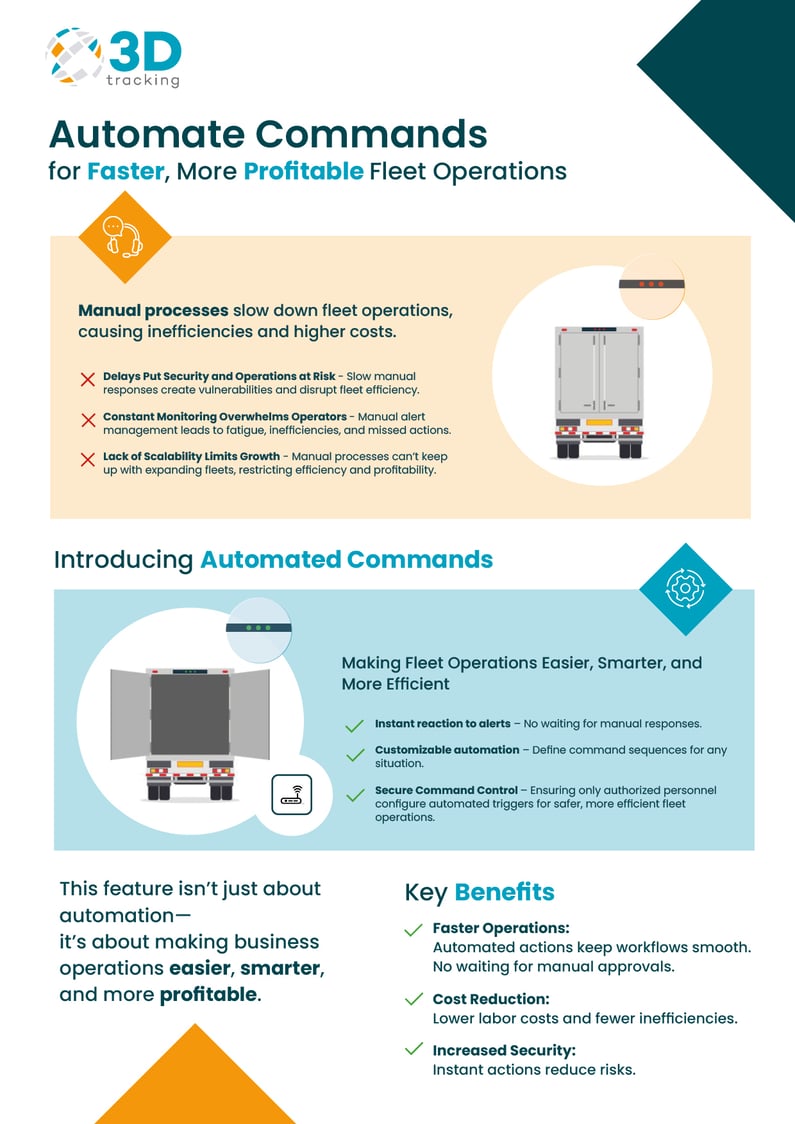
It’s 22:47. A high-value cargo truck pulls into a designated offloading zone. The driver stands by. The control room receives the alert, but nothing can happen until someone manually verifies the location and sends the command to unlock. Time ticks by.
Relying on a person to monitor alerts and trigger the next steps can cause frustration, but that’s not the only problem:
-
Critical actions are delayed, since operators cannot always respond instantly.
-
Operational inefficiencies, since companies handling large fleets or time-sensitive deliveries will struggle with the overhead of constant manual effort.
-
Security risks and compliance issues, because slow reaction times can compromise security and make adhering to regulations difficult.
The solution to these challenges is advanced tracking features, such as automated commands. This powerful functionality is available to all users on the 3Dtracking platform.
Common challenges without advanced tracking features
We recognized that without automated commands, fleet owners and managers were experiencing delays in response times, inefficiencies across their operations, and security gaps. These struggles were particularly evident in the logistics and mining industries. Closer investigation revealed:
Response delays
Without automation, operators must actively monitor alerts and manually verify conditions before taking action. Response times depend on human availability, which means an action might take minutes or even hours instead of happening instantly. In the meantime, fleet drivers, warehouse personnel, or security teams are forced to waste time waiting for approval or command execution.
-
Example: A truck driver arriving at a delivery site cannot access cargo until a control room operator verifies and manually sends an unlock command to a security padlock. If the operator is busy, the driver has to wait. This disrupts their delivery schedule.
Inefficiencies
A fleet of 1,000+ vehicles cannot scale if the business is still relying on manual processes. The burden on control room staff will increase and inevitably lead to overworked personnel unable to keep up with real-time demands, human errors in issuing the correct commands at the right time, and rising hiring costs as more staff are needed to manage manual command execution.
-
Example: Take mining operations, for instance, where vehicles must often be remotely immobilized in hazardous situations. If the operator relies on manual approvals when immediate action is required, risk exposure will increase.
Security and compliance risks
Transporting high-value goods carries an inherent risk of theft and unauthorized access. Manual intervention makes the situation more perilous since any security delays can lead to theft and fraud, and human error and slow responses can mean non-compliance with standard operating procedures.
-
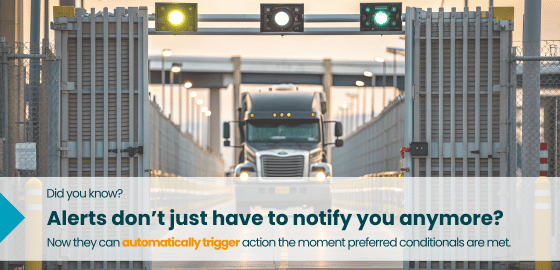
Example: Picture a high-value goods vehicle arriving at an offloading point, but due to a delay in manually issuing an unlock command, security personnel are left waiting around unnecessarily. Every minute wasted increases exposure to potential threats.
The benefits of advanced tracking features in fleet management
Replacing human intervention with advanced tracking features means less risk of security breaches and quicker, more reliable actions in time-sensitive scenarios. It means letting automation do the heavy lifting, while human beings focus on the tasks best suited for their skillsets. The benefits include:
Faster response times
Before automation, an operator received an alert and waited several minutes (or even longer) to issue a command. But after automated commands, the system executes the command instantly once the conditions of the configured alert are met.
Lower operational costs
When fewer actions rely on control room operators, businesses don’t need to scale staffing at the same pace as fleet growth. Automated commands also make sure that security and operational rules are followed consistently - no more human errors. And lastly, fewer delays and seamless processes ultimately bring down the costs of overtime and vehicle fuel wastage.
Improved security and compliance
Improved security and compliance come from enforcing rules automatically, instead of relying on human timing. For high-value asset transport, safe unlocking can be configured to occur only at approved locations and only after specific conditions are met. Vehicles can also be immobilized immediately if unauthorized movement is detected, which reduces the risk of theft.
Every automated command is also logged. This creates a clear audit trail that makes it easier to uphold regulatory compliance obligations.
The flexibility of automated commands
Automated commands are not a one-size-fits-all solution. Fleet operators can easily define which actions should be executed automatically based on a wide range of conditions, making sure the feature aligns with their industry-specific challenges and processes.
Automated commands work best in conjunction with other functionality on the 3Dtracking platform:
-
Reporting tools allow users to monitor and review command execution history.
-
Users can set and adjust alert conditions within the compound alert.
“We pride ourselves on the availability, flexibility, and consistency of our support, platform, and the value we offer to partners and their clients.” - Merick Singh, Head of Customer Success.
How to set up advanced tracking features
Automated commands are access-controlled, so 3Dtracking platform administrators must first grant the necessary permissions to users.
Once access is provided, users can configure automation rules. They must set compound alert conditions that will then trigger specific automated commands.
With this streamlined setup, fleet operators can easily implement automation to improve efficiency and security, without adding complexity to their operations.
Contact the 3Dtracking team for a demo of our advanced tracking solutions.